Executive Summary
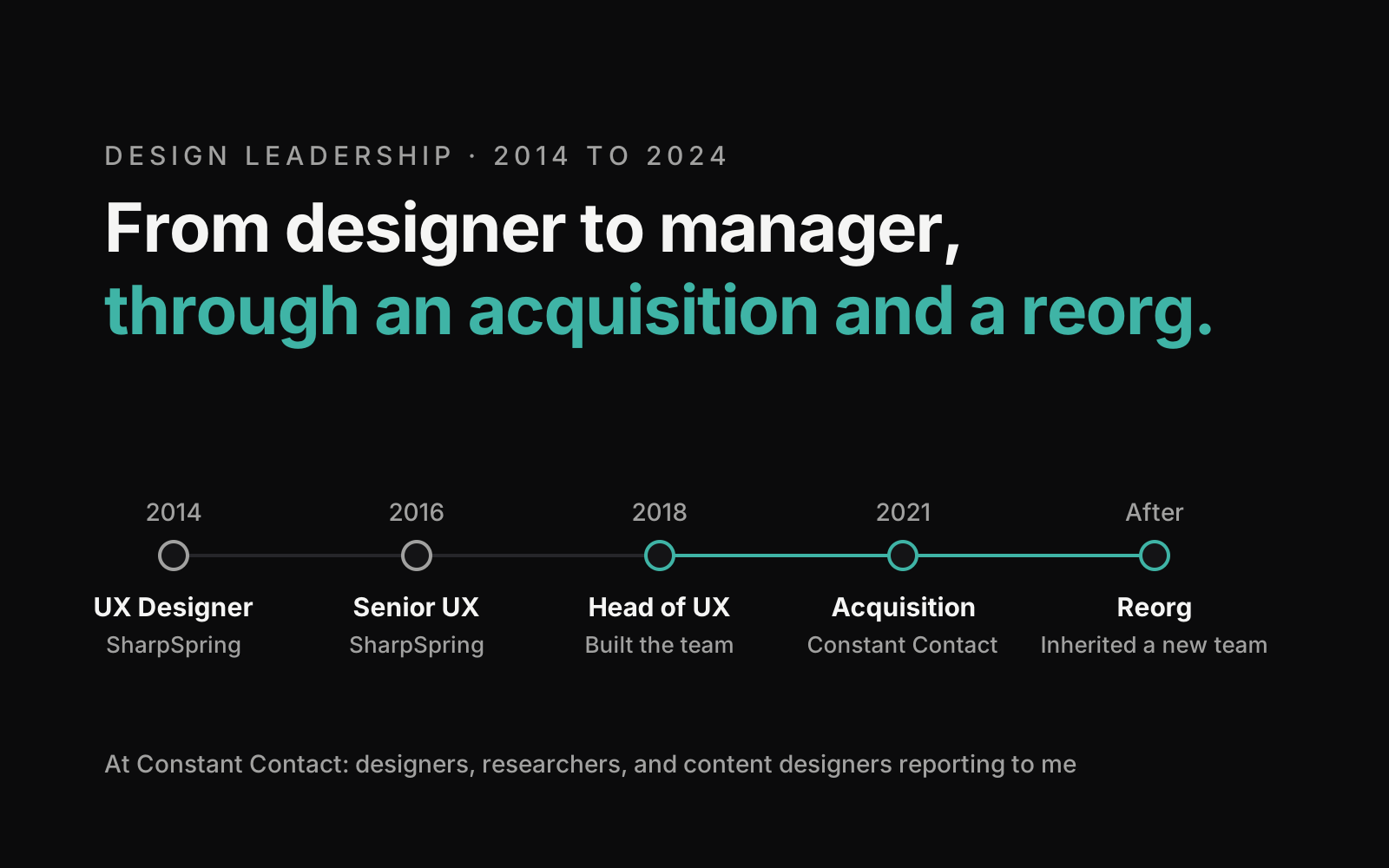
I joined SharpSpring as a UX designer in 2014 and left Constant Contact as a Product Design Manager in 2024. In between I went from running critique without any formal authority to managing the team, hiring for it, and building the routines it ran on. Then I carried that team through the Constant Contact acquisition, and after the reorg that followed, I took over a completely different set of people.
At Constant Contact my reports weren't only designers. Researchers and content designers reported to me too, so most of the work I was responsible for was work I couldn't do myself.
~5 yrs
Managing a design team at SharpSpring and Constant Contact
3
Disciplines reporting to me: product design, research, and content design
2
Org changes led through: an acquisition, then a reorg and a new team
The Starting Point
Before I had the title, I was the person running design critique. That's a useful way to start managing, because nobody has to listen to you. The only authority you have is whether your feedback actually makes the work better.
When I became the team's manager, the job changed from giving good feedback to building a team that gives good feedback without me in the room. I hired to grow the team and set up the routines it ran on: 1:1s, group critique, design reviews, a hiring loop, and performance reviews.
The rule I tried to hold in critique was to give my reasoning, not a verdict. "Move this button" teaches nothing. Explaining why it should move teaches the designer how to make the next call without me.
Leading Work I Can't Do Myself
Managing researchers and content designers at Constant Contact meant judging quality in crafts that aren't mine. I can't run a better study than a good researcher, and I can't write a better content system than a good content designer. So I had to get good at asking the questions that reveal whether the work is sound: what did the research actually rule out, what would make this message wrong for a new user, what are we assuming that we haven't checked.
That turned out to be the most useful management skill I have. It's also the reason I don't take over designers' work: I spent years leading people whose work I couldn't take over even if I'd wanted to.
Developing a Designer: From Intern to Design Lead
Savannah Chase came to SharpSpring as an intern from graphic design, with no product experience. That was a bet. Her craft was already excellent. What she didn't have yet was the product side: working inside a system somebody else defined, taking group critique, and thinking in flows and user stories instead of compositions.
I ran it as a ladder:
- Stay close early. I was involved in each of her first small projects.
- Pair for the actual gap. Her gap was product thinking, so I paired her with a product manager rather than another designer.
- Step back and use the routines. I tracked progress through our 1:1s and team reviews instead of hovering over the work.
- Escalate scope as it's earned. More complex projects, then design system contributions.
- Hand her something real. A net-new product that required extending the design system with new components.
She came in new to working inside a defined system and left having added to it. I made the case to hire her full time. Today she leads growth design at Noom, and we still keep in touch.
He has a calm, steady way of helping people grow without trying to shape them into a particular mold.
A Hiring Mistake I Own
Not every hire worked. I hired a designer who interviewed very well, and I never tested him on real work under real deadlines. He consistently missed the turnaround times we agreed on, and the quality wasn't where it needed to be. I set explicit expectations, checked in against them over about three months, and gave him more than one chance. He didn't get there, and I let him go.
I take two lessons from it. First, the hire: any interview loop I run will include a practical exercise, because the shortcomings would have shown up in one. Second, the management: I restated the target more than I diagnosed the cause. Next time I'd spend more time on why someone isn't getting there before deciding they can't.
Through an Acquisition
When Constant Contact acquired SharpSpring, my team joined the larger company intact and ran as a new team inside it for about a year.
I couldn't control that the org was in motion. I could make sure my team's week still looked the same: 1:1s happened, critique happened, we still did team things. People do good work when their environment is predictable, and when everything above you is uncertain, the manager is the only source of predictability left. I spent my energy absorbing the uncertainty instead of passing it down.
He's the best manager I've had in my entire career.
When layoffs came and the team lost people, I told the people who remained what I'd been told: their jobs were safe, and no one was in trouble. That second part matters. In a layoff, people quietly assume the cuts were about performance and start auditing themselves. The team kept shipping through it.
Inheriting a Team I Didn't Build
After the acquisition, a reorg shuffled the teams and I became manager of a completely new group of people. Building a team and inheriting one are different jobs. The people you inherit didn't choose you, and they already have a way of working.
What I took from it: a reorg is an information problem before it's an emotional one. People fill silence with the worst story available, so the manager has to be the most reliable narrator in the room: here's what I know, here's what I don't, here's when I'll know more. Keep the routines running, and say out loud what isn't changing.
The Product Work
The team was responsible for real B2B product outcomes, not just process:
- Upsell flows at Constant Contact. I oversaw and guided the team through the in-product flows designed to move customers onto a higher plan.
- Daily active usage was a metric the team designed against.
- Marketplace concepts at SharpSpring. Proof-of-concept designs for marketplace features.
- Complex workflow UX for agencies managing marketing automation across many client accounts.
Earlier product work from this period lives on my Behance profile.
What Carried Forward
- A designer I hired as an intern now leads growth design at Noom.
- The team stayed intact through the acquisition and kept shipping through the layoffs.
- Designers who reported to me have written about working with me on LinkedIn.
- At Neurotone I've spent the last two years as a hands-on lead, which is why I still prototype in code and stay close to the work. I'm looking to lead a team again, with more than I had when I left management.